
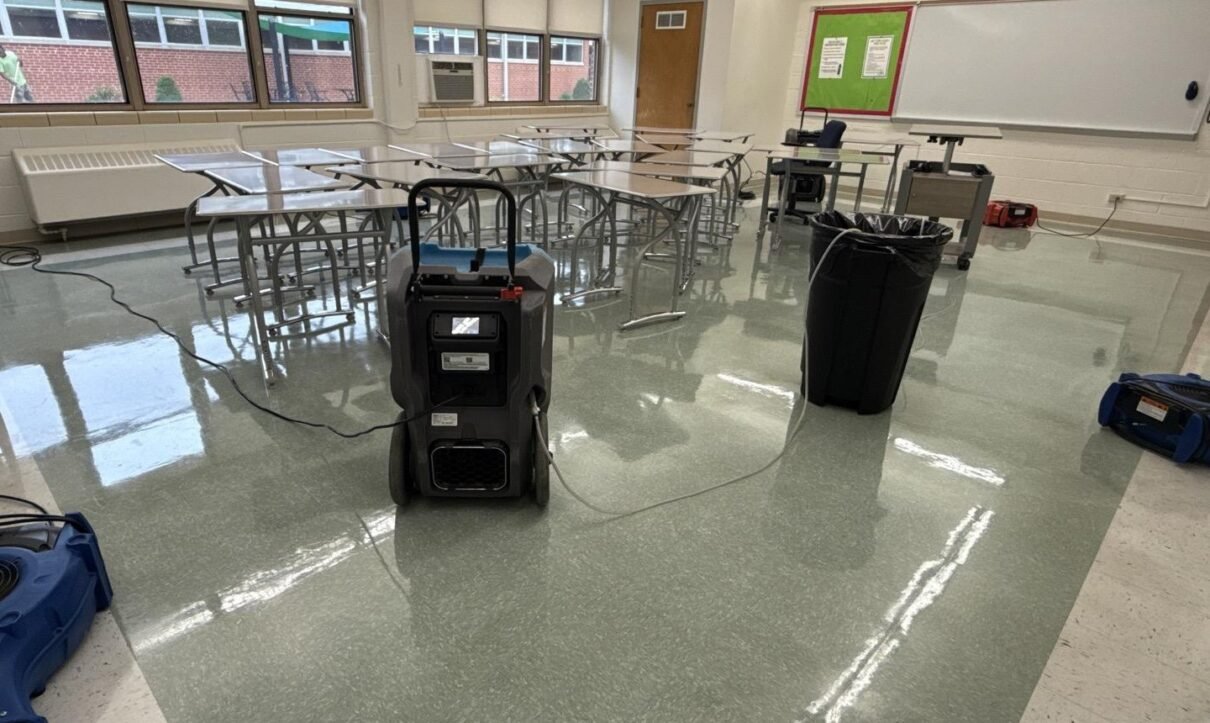
Water damage in a commercial building can turn into a serious operational problem very quickly. A burst pipe over the weekend, a roof failure during severe weather, a sprinkler system discharge, flooding, or water left behind after a fire can affect far more than the area where the problem first appears. Water can move through flooring, walls, ceiling systems, insulation, furniture, and other materials, making the true extent of the damage difficult to judge from a quick visual inspection.
For businesses and commercial property owners in St. Charles County, a fast response matters. Removing standing water is only the first step. The affected structure needs to be evaluated for hidden moisture, properly extracted and dried, monitored as conditions change, and cleaned or repaired where necessary.
At St. Louis Cleaning and Restoration, we have provided cleaning and restoration services since 1991. Our services include 24/7 emergency response, commercial and residential restoration, water damage restoration, fire damage restoration, mold remediation, and commercial cleaning.
For commercial properties in St. Charles, St. Peters, O’Fallon, and surrounding areas, the objective is straightforward: respond quickly, determine how far the water has traveled, remove the moisture, and help get the property back to normal with as little unnecessary disruption as possible.
Why Commercial Water Damage Requires a Fast Response
Water damage rarely remains confined to the place where the water is visible.
When water enters a commercial property, gravity, absorbent materials, and the construction of the building can allow it to move into surrounding areas. Water from a broken pipe above an office may travel through ceiling materials and walls before reaching the floor. A flooded hallway can leave moisture beneath carpet, flooring, baseboards, or adjacent walls even after the standing water has been removed.
This is why time plays such an important role in professional water damage restoration.
The longer materials remain wet, the greater the opportunity for secondary problems such as swelling, deterioration, staining, odors, damaged finishes, and microbial growth. What begins as an extraction job can eventually require considerably more repair if moisture remains trapped inside the building.
For a business, there is another concern: downtime. Water damage can close offices, restrict customer access, interrupt tenant operations, damage inventory, and make portions of a facility unusable.
Our commercial water damage restoration work in St. Charles is designed to respond to those concerns quickly so that water can be removed and the drying process can begin. Our broader restoration services are available around the clock because emergencies do not necessarily happen during normal business hours.
Water Can Spread Far Beyond What You Can See
One of the biggest mistakes after a commercial water loss is assuming that a surface is dry because it looks dry.
A floor may appear normal while the material beneath it still contains moisture. Drywall may feel dry on the exposed surface while moisture remains inside a wall cavity. Carpet may no longer feel saturated even though the carpet backing or material underneath is still wet.
For that reason, professional water restoration involves moisture detection as well as extraction.
At St. Louis Cleaning and Restoration, we use moisture meters during the restoration process to help identify where moisture is concentrated and where drying efforts need to be focused. Once affected areas have been identified, extraction and drying can be directed toward the areas where they are needed.
Comprehensive detection is particularly important in commercial buildings because water can move through interconnected rooms, hallways, flooring systems, utility spaces, and building materials before anyone realizes how far it has traveled.
Delayed Drying Can Lead to Additional Damage
The faster a water problem is addressed, the more opportunity there is to limit additional damage.
Materials react differently when exposed to water. Wood can swell or warp. Drywall can soften or deteriorate. Carpet and padding can retain water beneath the visible surface. Upholstery and fabrics can absorb moisture. Trim and other building materials may begin to separate, discolor, or change shape.
The U.S. Environmental Protection Agency recommends responding to water-damaged materials within approximately 24 to 48 hours when possible to help prevent mold growth. The EPA also notes that drying methods can include water extraction, dehumidification, and increased air movement, depending on the type of material involved.
That time frame is a useful reminder that waiting several days to see whether a commercial building “dries out on its own” can create additional problems.
Commercial Water Damage and the Risk of Mold
Water damage and mold remediation are closely related, although they are not the same service.
Water damage restoration focuses on locating and removing water, drying the structure, cleaning affected areas, and repairing damage where necessary. Mold remediation addresses microbial contamination that has already developed.
The goal after a water loss is to control moisture before it has an opportunity to become a larger problem.
The EPA explains that mold can grow in damp areas and that buildings, building materials, and furnishings should be dried quickly after becoming wet.
If microbial contamination is discovered during the restoration process, St. Louis Cleaning and Restoration also provides mold remediation services. Our mold remediation work uses HEPA filtration equipment, and our technicians evaluate the scope of contamination so an appropriate action plan can be developed.
Having water damage restoration and mold remediation capabilities available through the same restoration company can be particularly useful when an emergency develops into a more complicated project.
Common Causes of Commercial Water Damage in St. Charles County
Commercial water damage can originate from many different sources. Some develop gradually, while others flood portions of a building within minutes.
Flooding and Severe Weather
Flooding is an especially relevant concern in St. Charles County. St. Charles County identifies flooding as a common local issue and notes that its location along both the Missouri and Mississippi rivers leaves residents and businesses vulnerable to flood risk.
Heavy rain and severe storms can also contribute to water intrusion through roofs, entrances, drainage systems, and lower portions of commercial buildings.
Businesses located in areas with known flood exposure should consider emergency planning before an event occurs, including knowing who will be responsible for contacting restoration professionals, documenting damage, communicating with tenants, and coordinating insurance information.
Burst and Leaking Pipes
Broken plumbing is one of the more common ways a commercial property can experience significant water damage.
Problems can include:
- Burst supply pipes
- Failed fittings or plumbing connections
- Leaking pipes inside walls
- Frozen pipes
- Broken fixtures
- Failed water heaters
- Plumbing failures above ceilings
A plumbing problem can be particularly damaging when it occurs overnight, during a weekend, or in an area of the property that is not regularly occupied.
Roof Leaks and Roof Damage
A roof problem may begin as a small leak but can affect ceilings, walls, insulation, flooring, and furnishings below.
During severe weather, larger roof failures can introduce substantial amounts of water in a short period of time. Even after the roof itself is addressed, the interior building materials still need to be evaluated and dried.
Fire Sprinkler System Discharges
Commercial sprinkler systems can release a significant volume of water when activated.
Even when the system performs exactly as intended during a fire, the building may be left with water damage in addition to smoke, soot, and fire damage. Accidental or malfunctioning sprinkler discharges can also create restoration needs.
Water Used to Extinguish a Fire
Fire restoration frequently includes a water restoration component.
Once firefighters have extinguished a commercial building fire, water may remain in flooring, walls, furnishings, contents, and other materials. St. Louis Cleaning and Restoration provides both fire damage restoration and water damage restoration, which allows related damage from the same incident to be addressed as part of the overall recovery process.
What to Do Immediately After Commercial Water Damage
The first priority after any major commercial water loss should be safety.
Do not enter areas where electrical hazards, unstable ceilings, contaminated water, structural damage, or other dangerous conditions may be present.
Once the situation is safe enough to manage, several steps can help limit additional damage.
Stop the Water Source When It Is Safe to Do So
If the water is coming from a plumbing system and the appropriate shutoff can be safely accessed, stopping the water can prevent the situation from becoming worse.
Other situations may require a plumber, utility provider, roofing contractor, fire department, building engineer, or other appropriate professional.
Protect People From the Affected Area
Keep employees, customers, tenants, and visitors away from damaged areas until the condition of the space has been evaluated.
Water can create slippery flooring, electrical risks, falling ceiling materials, and other hazards that may not be immediately obvious.
Document the Damage
Take photographs and videos before materials are moved or discarded when it is safe to do so.
Commercial property owners may also want to document:
- Damaged inventory
- Equipment
- Furniture
- Flooring
- Walls and ceilings
- Important documents
- Affected tenant spaces
- Time and date the water was discovered
- Known source of the loss
- Emergency repairs or services
Good documentation can make later communication with the property owner, tenants, insurance representatives, and restoration professionals easier.
Call for Professional Water Damage Restoration
Large commercial losses generally require more than simply removing visible standing water.
Professional restoration allows the property to be evaluated for moisture that may have moved into materials and areas that are not immediately visible.
Our Commercial Water Damage Restoration Process
Every water loss is different, so the exact restoration process depends on the water source, size of the affected area, building materials involved, and how long the property has been wet.
A commercial restoration project commonly involves several stages.
Initial Assessment and Damage Evaluation
The first step is determining what happened and how extensively the property has been affected.
The initial assessment may consider:
- The source of the water
- Areas with visible water
- Adjacent rooms
- Flooring systems
- Walls and ceilings
- Furniture and contents
- Potential hidden moisture
- Areas that need immediate stabilization
A good assessment creates the foundation for the rest of the restoration process.
Moisture Detection and Monitoring
Visible water tells only part of the story.
We use moisture meters to identify areas where elevated moisture is present and to help guide drying efforts. Monitoring also allows our team to determine how materials are responding as the project progresses.
This is important because commercial drying is not simply a matter of placing equipment in the room and coming back later. Conditions can change during the process, and affected materials may dry at different rates.
Water Extraction
Standing water should be removed as quickly as conditions allow.
Efficient extraction reduces the amount of water that must subsequently evaporate from building materials, which can help make the overall drying process more efficient.
Our water removal and extraction capabilities can address water affecting a range of materials and areas, including:
- Floors
- Carpet
- Drywall
- Fabrics
- Trim
- Wood
- Furniture
Professional water extraction is often only the beginning. Once excess water has been removed, remaining moisture still needs to be addressed through controlled drying.
Structural Drying and Dehumidification
After extraction, drying equipment can be used to reduce moisture remaining in the structure and its contents.
Depending on the situation, restoration may involve air movement, dehumidification, drying equipment, and ongoing monitoring.
The EPA’s guidance for water-damaged commercial buildings similarly identifies extraction, dehumidification, air movement, and drying of affected materials as important parts of responding to clean water damage.
At St. Louis Cleaning and Restoration, we use drying and monitoring equipment to help stabilize affected environments and move the restoration process forward.
We are also a certified structural drying company, which is particularly relevant when moisture has moved beyond the surface and into building materials.
Cleaning, Sanitizing, and Deodorizing
Water damage can leave behind more than moisture.
Depending on the source of the water and the materials affected, the restoration process may also involve cleaning, sanitizing, and deodorizing.
These steps can help address odors, residues, and other conditions that remain after extraction and drying.
The correct process depends heavily on the water source. Clean water from a supply line is different from contaminated water, and each situation needs to be approached accordingly.
Removing Materials That Cannot Be Restored
Professional restoration does not mean trying to save every material at all costs.
Some building materials may be too damaged, contaminated, deteriorated, or saturated to restore effectively.
For example, EPA guidance distinguishes between materials that can sometimes be dried and materials that may need to be discarded depending on their condition. Ceiling tiles and certain insulation materials may require replacement, while wallboard may sometimes be dried in place if it has not swollen and its seams remain intact.
The objective is to make sensible restoration decisions based on the condition of the material rather than simply covering up damage.
Repairs and Restoration
Once moisture has been controlled, repairs can begin where needed.
Our restoration services can include the work necessary to move the property from emergency stabilization toward normal use again. The exact scope depends on how much damage occurred and which materials could be successfully dried and restored.
Final Inspection
The end of a restoration project should involve more than removing the equipment.
We perform a final inspection to make sure the restoration needs identified during the project have been addressed.
For commercial owners and managers, this provides an opportunity to review the work before moving fully back into normal operations.
Why Commercial Water Damage Is Different From Residential Water Damage
The fundamental principles of water restoration are similar in homes and businesses, but commercial properties introduce additional complications.
Commercial Buildings Are Often Larger
A commercial water loss may affect thousands of square feet rather than one or two rooms.
The building may include:
- Multiple floors
- Offices
- Retail spaces
- Warehouses
- Common areas
- Mechanical rooms
- Tenant spaces
- Storage areas
- Commercial kitchens
- Production areas
Water may also move between interconnected spaces before the source is discovered.
Business Continuity Matters
A homeowner wants to get back into a house. A commercial owner may simultaneously be trying to keep a company operating.
That makes decisions about containment, access, equipment placement, drying schedules, repairs, and communication especially important.
Whenever conditions permit, restoration planning should consider whether unaffected areas can remain operational while damaged portions are being restored.
There May Be Multiple Decision Makers
A commercial water loss can involve:
- Business owners
- Property owners
- Facility managers
- Property management companies
- Tenants
- Insurance adjusters
- Maintenance teams
- Contractors
Clear communication helps keep everyone working from the same understanding of what has been affected and what is happening next.
Reducing Business Downtime During Water Damage Restoration
Getting a commercial property operational again is an important part of restoration.
That does not mean rushing through the drying process. It means organizing the work intelligently.
Prioritize Critical Areas
Certain portions of the property may be more important to restoring operations than others.
For example, priority might be given to:
- Main entrances
- Customer service areas
- Essential offices
- Production areas
- Tenant entrances
- High-value inventory areas
- Critical equipment rooms
Separate Damaged and Undamaged Areas
When practical, affected areas may be isolated while unaffected portions of the property continue operating.
Every loss is different, but thoughtful project planning can sometimes reduce the amount of the building that must remain inaccessible.
Communicate With Employees and Tenants
People need to know which areas are safe to use, which areas are restricted, and how the restoration work may affect normal schedules.
Good communication can prevent confusion while technicians work through extraction, drying, monitoring, and repairs.
Commercial Water Damage Restoration and Insurance Claims
Insurance coverage varies significantly depending on the policy and the cause of the water loss, so businesses should confirm coverage directly with their insurance carrier or insurance professional.
Good documentation can still make the claims process easier.
Photographs, videos, inventories of damaged property, restoration records, and records of emergency work can all help establish what occurred.
St. Louis Cleaning and Restoration can also provide insurance claim assistance as part of our water restoration services. That does not mean every loss will be covered, but having organized information from the restoration process can help make communication with the insurance company more straightforward.
Commercial Water Damage Restoration in St. Charles, MO
St. Charles contains a mix of offices, retail properties, restaurants, industrial buildings, apartment communities, schools, institutions, and other commercial facilities.
Different buildings create different restoration challenges, but the fundamentals remain the same: identify the source, determine the extent of the moisture, extract water, dry affected materials, monitor progress, and complete any necessary cleaning or repairs.
We provide water damage restoration specifically for St. Charles businesses and commercial properties, along with our other restoration and commercial cleaning services.
Commercial Water Damage Restoration in St. Peters, MO
Businesses in St. Peters can experience the same plumbing failures, storm damage, sprinkler discharges, roof leaks, and other emergencies that affect properties elsewhere in St. Charles County.
A quick response is particularly important when an incident affects customer-facing areas, employee workspaces, inventory, or tenant spaces.
Our service area includes St. Peters as well as St. Charles and other communities throughout the greater St. Louis area.
Commercial Water Damage Restoration in O’Fallon, MO
O’Fallon businesses and property managers may also need commercial restoration after plumbing failures, severe weather, flooding, roof damage, or other water emergencies.
Commercial properties can range from individual offices and storefronts to much larger facilities, so the restoration plan should reflect the actual size and complexity of the loss rather than taking a one-size-fits-all approach.
What to Look for in a Commercial Water Damage Restoration Company
When a business is dealing with water damage, choosing the right restoration company can have a major effect on how smoothly the recovery process goes.
Several capabilities are worth considering.
24/7 Emergency Availability
A burst pipe at 2 a.m. cannot always wait until the next business day.
Our emergency response teams are available 24 hours a day, seven days a week for restoration emergencies.
Professional Moisture Detection
The restoration company should be looking for hidden moisture, not simply removing the water that can be seen.
Moisture meters and ongoing monitoring help determine where drying is needed and whether affected materials are responding.
Water Extraction and Structural Drying Equipment
Commercial restoration typically requires professional equipment capable of handling larger volumes of water and drying a variety of materials.
Experience With Commercial Properties
Commercial restoration involves more than drying the building.
The restoration team may need to work around tenants, employees, customers, equipment, inventory, operating schedules, and other contractors.
Related Restoration Capabilities
Water emergencies can create other problems.
A company that provides water damage restoration, mold remediation, fire restoration, and commercial cleaning can address related restoration needs without treating each issue as completely separate.
At St. Louis Cleaning and Restoration, our restoration services are designed to cover those interconnected needs. We have been serving St. Louis area families, businesses, and corporations since 1991, with an emphasis on trained technicians and professional restoration services.
Frequently Asked Questions About Commercial Water Damage Restoration in St. Charles County
How quickly should I call after discovering commercial water damage?
As soon as the immediate safety situation is under control. Water can migrate into materials and concealed areas quickly, so delaying assessment and drying may allow additional damage to develop.
EPA guidance generally recommends responding to water-damaged materials within 24 to 48 hours when possible to reduce the potential for mold growth.
Can my business stay open during water damage restoration?
Sometimes. It depends on the source and extent of the water, safety conditions, the layout of the property, and which areas are affected.
In some situations, an unaffected portion of the building may continue operating while restoration work takes place elsewhere. Larger or more hazardous losses may require temporary closure.
How long does commercial structural drying take?
There is no single timeline that applies to every building.
Drying time depends on the amount of water, how long the materials were wet, the type of materials affected, environmental conditions, and the extent of moisture migration.
Moisture monitoring is more reliable than assuming that every water loss should be dry after a predetermined number of days.
Can wet carpet and drywall be saved?
Sometimes.
The answer depends on the source of the water, how long the material remained wet, the amount of water involved, contamination, and the physical condition of the material.
EPA guidance notes that carpet and backing may be dried after clean water damage when addressed quickly, while wallboard may sometimes be dried in place when it has not swollen and the seams remain intact.
How do you find water behind walls or beneath flooring?
Professional moisture detection equipment can help identify elevated moisture that may not be visible from the surface. We use moisture meters to guide our restoration work and determine where extraction and drying efforts should be concentrated.
What happens if mold is discovered?
The situation may require mold remediation in addition to the original water restoration work.
St. Louis Cleaning and Restoration provides mold remediation and uses HEPA filtration equipment as part of our approach to microbial contamination.
Does commercial property insurance cover water damage?
It depends on the policy and what caused the damage.
A sudden plumbing failure may be treated differently from flooding, long-term leakage, or maintenance-related problems. Contact your insurance carrier or insurance professional to determine what applies to your specific loss.
Do I still need restoration if the standing water is gone?
Possibly. Removing standing water does not necessarily mean the building is dry.
Moisture may remain beneath flooring, inside drywall, around trim, behind walls, in wood, or inside other porous materials. Professional moisture detection can help determine whether additional drying is needed.
Helping St. Charles County Businesses Get Back to Normal After Water Damage
Commercial water damage restoration is ultimately about more than getting water off the floor.
A thorough response means determining how far the moisture has traveled, extracting water, drying affected materials, monitoring moisture levels, cleaning and sanitizing where appropriate, addressing damaged materials, completing repairs when necessary, and verifying that the restoration process has been completed properly.
For St. Charles County businesses, acting quickly can help limit unnecessary damage and reduce the disruption caused by the original loss.
St. Louis Cleaning and Restoration has provided professional cleaning and restoration services since 1991. Our team offers 24/7 emergency response along with commercial water damage restoration, structural drying, fire damage restoration, mold remediation, commercial cleaning, and related services for businesses throughout the St. Louis and St. Charles areas.
If your office, retail property, commercial building, apartment complex, facility, or other business property has experienced water damage, you can contact St. Louis Cleaning and Restoration to discuss the situation and the next steps for restoring your property.